
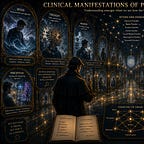

Imagine Medlock Holmes entering a vast hall of mirrors.
Each mirror reflects a different aspect of human experience: mood, thought, perception, memory, behaviour, identity, motivation, and consciousness. Most reflections remain coherent and integrated. Yet in some mirrors, subtle distortions begin to appear. A thought becomes fixed. An emotion becomes overwhelming. A perception no longer matches reality. A behaviour loses its adaptive purpose.
Holmes quickly realises that psychiatric disorders rarely announce themselves through laboratory tests or imaging findings. Instead, they reveal themselves through clinical manifestations—the observable and reported experiences that provide clues to underlying psychological and neurobiological processes.
This chapter serves as a guide to the language of psychopathology. It explores how psychiatric disorders present across multiple domains of mental functioning, including disturbances of mood, anxiety, cognition, perception, thought processes, thought content, behaviour, and consciousness.
A central theme is that symptoms rarely occur in isolation. Depression may present not simply as sadness, but as altered sleep, diminished concentration, loss of motivation, guilt, hopelessness, and psychomotor change. Psychosis may involve hallucinations, delusions, disorganised thinking, emotional disturbance, and behavioural abnormalities. Anxiety may manifest cognitively, emotionally, physiologically, and behaviourally.
The chapter introduces the clinician’s task of transforming observations into meaningful patterns. Individual symptoms become syndromes; syndromes become diagnoses; diagnoses become frameworks for understanding and treatment.
Particular attention is given to the distinction between symptoms and signs. Symptoms are the subjective experiences described by patients, while signs are the objective observations made by clinicians. Both are essential components of psychiatric assessment.
The chapter also explores the importance of context. Similar manifestations may arise from very different causes. Agitation may reflect mania, psychosis, anxiety, substance use, delirium, personality factors, or medical illness. Understanding psychiatric symptoms therefore requires both careful observation and thoughtful interpretation.
Ultimately, this chapter teaches that psychiatric assessment is a process of pattern recognition. The clinician becomes an investigator of human experience, learning to recognise how disorders reveal themselves through the language of the mind.
Key Takeaways
Psychiatric disorders are identified through clinical manifestations rather than direct biological observation.
Symptoms are subjective experiences reported by patients.
Signs are objective findings observed by clinicians.
Mental disorders affect multiple domains including mood, cognition, perception, thought, behaviour, and consciousness.
Similar symptoms may arise from different underlying disorders.
Psychiatric assessment requires careful observation, listening, and interpretation.
Clusters of symptoms form syndromes that guide diagnosis.
Understanding context is essential when interpreting clinical presentations.
Pattern recognition is a fundamental clinical skill in psychiatry.
Clinical manifestations provide the foundation for diagnosis, formulation, and treatment planning.


