
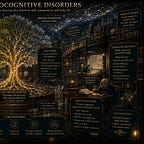

Imagine Medlock Holmes returning to the great library introduced in the previous chapter.
At first glance, the library still stands.
Its walls remain intact.
The shelves are still filled with books.
The familiar corridors continue to stretch into the distance.
Yet something profound has changed.
The librarians who once maintained the archives can no longer keep pace with the demands of the system.
Catalogues become incomplete.
Sections lose their organisation.
Books are misplaced and never returned.
Connections between different collections begin to disappear.
The library represents the human brain.
The gradual deterioration of its organisational systems represents a major neurocognitive disorder.
This chapter explores a group of conditions characterised by significant decline in one or more cognitive domains severe enough to interfere with independence and everyday functioning.
Unlike delirium, which develops rapidly and fluctuates, major neurocognitive disorders typically emerge insidiously. Their progression is often measured in months or years rather than hours or days.
Holmes quickly discovers that memory is only one part of the story.
Popular understanding often equates neurocognitive disorders with forgetfulness, but the reality is far more complex.
Different individuals may experience impairments in attention, language, executive functioning, visuospatial abilities, social cognition, learning, reasoning, judgement, or behavioural regulation.
The specific pattern depends on which neural systems are affected.
As Holmes explores the library, he notices that some wings deteriorate more rapidly than others.
One section struggles to create new memories.
Another loses the ability to navigate familiar spaces.
Elsewhere, language archives become difficult to access, while decision-making centres grow increasingly unreliable.
The disorder is not defined by the loss of a single function.
It is defined by a decline significant enough to affect daily life.
The chapter examines how clinicians identify major neurocognitive disorders through careful history-taking, cognitive assessment, functional evaluation, collateral information, neuropsychological testing, and medical investigation.
A central theme is the distinction between cognitive impairment and disability.
Many individuals experience minor cognitive changes without losing independence.
Major neurocognitive disorders are diagnosed when cognitive decline begins to impair essential activities such as managing finances, medications, transportation, communication, work responsibilities, or self-care.
Holmes also discovers that these disorders arise from diverse causes.
Neurodegenerative diseases.
Cerebrovascular disease.
Traumatic brain injury.
Substance-related conditions.
Infections.
Metabolic disorders.
Neurological illnesses.
Although the pathways differ, they converge upon a common destination: progressive disruption of the cognitive systems that support everyday life.
As the investigation continues, Holmes notices another important feature.
The disorder affects not only cognition but identity.
Families often describe subtle personality changes, altered emotional responses, shifts in social behaviour, or changes in decision-making long before severe cognitive deficits become apparent.
The person remains present, yet the ways in which they engage with the world gradually change.
The chapter also highlights the enormous impact on carers and families.
Neurocognitive disorders rarely affect individuals alone.
They alter relationships, roles, responsibilities, and future plans.
The challenge therefore extends beyond diagnosis to include support, adaptation, planning, and compassionate care.
Standing within the library’s central archive, Holmes observes some shelves dimming while others continue to glow brightly.
Even amidst decline, many strengths remain.
Procedural skills, emotional connections, creativity, humour, and personal values may persist long after other cognitive abilities have changed.
The lesson becomes clear.
Major neurocognitive disorders are not simply disorders of memory.
They are disorders of complex brain systems that support independent living, relationships, and personal identity.
The clinician’s task is not merely to identify decline, but to understand its pattern, determine its cause, and help individuals and families navigate the journey that follows.
Key Takeaways
Major neurocognitive disorders involve significant decline in one or more cognitive domains.
Cognitive decline interferes with independence and daily functioning.
Memory impairment is common but not universally present.
Multiple domains may be affected, including attention, language, executive function, visuospatial abilities, and social cognition.
Major neurocognitive disorders usually develop gradually over time.
Diagnosis requires assessment of both cognition and functional abilities.
Numerous medical and neurological conditions can cause major neurocognitive disorders.
Collateral history from family members is often essential.
The disorders affect identity, relationships, and quality of life as well as cognition.
Management focuses on diagnosis, support, adaptation, safety, and maintaining quality of life.


