
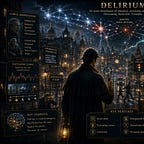

Imagine Medlock Holmes arriving in a bustling city that normally functions with remarkable precision.
Traffic flows smoothly.
Messages are delivered accurately.
Citizens recognise one another.
Markets open on time.
The entire system depends upon a continuous and reliable supply of energy.
One morning, however, something changes.
The city’s power grid begins to fluctuate.
Lights flicker unpredictably.
Communication systems fail intermittently.
Road signs appear distorted.
People become disoriented.
Some wander aimlessly through the streets.
Others become frightened and agitated.
A few appear withdrawn and barely responsive.
The city represents the brain.
The failing power grid represents delirium.
Unlike dementia, where the structure of the city gradually changes over time, delirium is a disorder of function.
The machinery remains largely intact.
The problem lies in the brain’s ability to maintain stable and coherent operation.
As Holmes investigates, he notices one crucial clue.
The disturbance developed rapidly.
Only yesterday the city was functioning normally.
Today it is profoundly altered.
This sudden onset becomes one of the defining characteristics of delirium.
Holmes soon discovers that attention is the first casualty.
Citizens cannot focus on conversations.
Instructions are forgotten moments after being given.
Thoughts drift unpredictably.
The city’s central communication network is no longer able to prioritise information.
Without attention, every other cognitive process begins to falter.
Memory becomes unreliable.
Perception becomes distorted.
Reasoning becomes fragmented.
Awareness fluctuates from hour to hour.
The city never fails in quite the same way twice.
As he walks through different districts, Holmes observes that delirium presents in remarkably different forms.
In one area, activity is frantic.
People pace constantly.
Voices are raised.
Fear and agitation dominate.
This is hyperactive delirium.
Elsewhere, the city appears quiet.
Citizens move slowly.
Responses are delayed.
People seem withdrawn and sleepy.
This is hypoactive delirium.
Holmes quickly realises that the quieter form is often more dangerous because it can easily be overlooked.
A third district alternates unpredictably between the two states.
Periods of agitation suddenly give way to profound lethargy.
This is mixed delirium.
The fluctuating nature of the syndrome becomes impossible to ignore.
Holmes then turns his attention to the source of the failing power supply.
He discovers that delirium is rarely a disease in itself.
Rather, it is a warning signal.
A manifestation of underlying physiological stress affecting the brain.
Infections.
Dehydration.
Medication effects.
Pain.
Metabolic disturbances.
Organ failure.
Withdrawal states.
Surgery.
Hospitalisation.
Almost any significant disruption to the body’s internal balance can destabilise the brain’s ability to maintain consciousness and attention.
The brain, Holmes realises, is acting as an early warning system for systemic illness.
The vulnerable city is particularly susceptible in older adults.
In those with pre-existing dementia, the power grid is already operating with reduced reserves.
Even minor disturbances can trigger widespread dysfunction.
This explains why delirium and dementia frequently coexist.
One does not exclude the other.
Indeed, dementia is among the strongest risk factors for developing delirium.
As Holmes investigates further, he discovers one of the most important lessons in medicine.
Delirium is often reversible.
If the underlying cause can be identified and treated, the city’s power can stabilise.
Communication systems recover.
Attention improves.
Orientation returns.
The citizens once again recognise the world around them.
Yet when delirium is missed, consequences can be severe.
Longer hospital stays.
Functional decline.
Falls.
Institutionalisation.
Increased mortality.
The syndrome demands urgent recognition.
The chapter concludes with Holmes standing before the city’s central power station.
The lesson becomes clear.
Delirium is not primarily a disorder of memory.
It is a disorder of attention, awareness, and consciousness.
A rapidly developing failure of the brain’s ability to maintain coherent functioning.
The flickering lights of the city are not the problem themselves.
They are signals pointing toward a deeper disturbance requiring immediate investigation.
For the skilled clinician, recognising those signals may be the difference between recovery and catastrophe.
Key Takeaways
Delirium is an acute disturbance of attention, awareness, and cognition.
Symptoms develop over hours to days and typically fluctuate throughout the day.
Impaired attention is the core clinical feature.
Delirium may present as hyperactive, hypoactive, or mixed subtypes.
It is usually caused by an underlying medical, neurological, toxic, or pharmacological condition.
Older adults and people with dementia are particularly vulnerable.
Delirium is a medical emergency that requires urgent assessment.
The condition is often reversible if the underlying cause is identified and treated.
Hypoactive delirium is common and frequently missed.
Delirium is associated with significant morbidity, mortality, and healthcare costs.


