
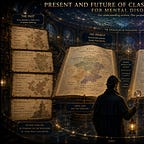

Imagine Medlock Holmes standing within a vast cartography chamber.
Spread before him are enormous maps of the mind created across different eras. Some are centuries old, hand-drawn and incomplete. Others are modern, precise, and densely detailed. Each attempts to answer the same question:
How should we classify mental disorders?
As Holmes examines the maps, he notices that none perfectly match the territory they describe.
Some regions are sharply defined, while others blur into one another. Boundaries shift over time. New territories emerge. Old territories disappear. Certain pathways appear interconnected despite being assigned to different regions.
This chapter explores the evolution, current state, and future direction of psychiatric classification systems.
The journey begins with the historical development of psychiatric diagnosis. Early systems relied heavily on observation and descriptive categories. Over time, psychiatry sought greater reliability by developing structured diagnostic frameworks that allowed clinicians to communicate using common language.
Holmes studies two great maps that dominate contemporary psychiatry: the Diagnostic and Statistical Manual of Mental Disorders (DSM) and the International Classification of Diseases (ICD). These systems provide standardised criteria that improve diagnostic consistency, facilitate research, guide treatment planning, and support communication across healthcare systems.
Yet Holmes quickly discovers their limitations.
Many disorders overlap significantly. Patients frequently meet criteria for multiple diagnoses. Individuals with the same diagnosis may present very differently. Biological findings often fail to align neatly with existing categories. The boundaries between normality and disorder can sometimes appear uncertain.
The chapter examines one of psychiatry’s central dilemmas: whether mental disorders are best understood as distinct categories or as dimensions that exist along continua. Increasing evidence suggests that many symptoms may be better represented dimensionally rather than as rigid diagnostic boxes.
Holmes encounters emerging frameworks that attempt to move beyond traditional classification. Research Domain Criteria (RDoC) seeks to organise psychopathology according to underlying neurobiological and psychological systems. Other approaches focus on symptom networks, transdiagnostic processes, developmental trajectories, and personalised models of mental illness.
As he moves deeper into the chamber, Holmes notices that future maps are becoming layered rather than singular. Biological markers, genetics, cognitive processes, environmental influences, developmental factors, and lived experience are increasingly integrated into multidimensional models.
The chapter concludes with a recognition that classification systems are tools rather than truths. Their purpose is not to perfectly define reality, but to provide useful frameworks that improve understanding, communication, research, and patient care.
Holmes leaves the chamber with a profound insight:
The map will always evolve because the territory is more complex than any single system can fully capture.
Key Takeaways
Psychiatric classification systems provide structured frameworks for diagnosing mental disorders.
Modern classification relies primarily on DSM and ICD systems.
Classification improves reliability, communication, research, and treatment planning.
Diagnostic categories are useful but imperfect representations of clinical reality.
High rates of symptom overlap and comorbidity challenge traditional diagnostic boundaries.
Many psychiatric phenomena may exist along dimensions rather than discrete categories.
Biological findings often do not map neatly onto current diagnoses.
Emerging approaches include RDoC, transdiagnostic models, and network-based frameworks.
Future classification systems may integrate biological, psychological, social, and developmental factors.
Classification systems are evolving tools designed to improve understanding and care rather than definitive descriptions of mental illness.


