
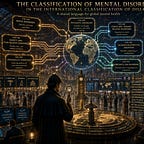

Imagine Medlock Holmes arriving at an immense international railway terminal.
Thousands of travellers move through the station every hour. They come from different nations, cultures, languages, and healthcare systems. Yet somehow they all manage to navigate using a single set of signs, symbols, and destinations.
Holmes quickly realises that this station represents the global healthcare system.
The signs guiding every traveller are part of a vast classification framework known as the International Classification of Diseases (ICD).
As Holmes begins his investigation, he discovers that the ICD is far more than a list of diagnoses. Developed and maintained by the World Health Organization, it serves as the world’s primary system for classifying diseases, disorders, injuries, and causes of death.
Within one wing of the station lies the Department of Mental, Behavioural and Neurodevelopmental Disorders.
Here Holmes finds an intricate network of routes representing the many forms of human psychological suffering. Some pathways describe mood disorders. Others lead toward psychotic disorders, anxiety disorders, personality disorders, neurodevelopmental conditions, substance use disorders, and disorders related to stress and trauma.
Each destination has been carefully defined so that clinicians from vastly different settings can recognise and communicate about similar presentations.
Holmes notices that the ICD differs slightly from other diagnostic systems.
Its purpose is fundamentally global.
The classification must work not only in major academic centres and specialist psychiatric services, but also in rural clinics, developing healthcare systems, emergency departments, primary care settings, and public health programmes throughout the world.
As he studies the architecture of the station, Holmes observes that the latest edition, ICD-11, was designed to improve clinical utility. Diagnostic guidelines aim to be practical, flexible, and applicable across diverse cultures and healthcare environments.
The chapter explores how ICD mental disorder classifications are organised, including major diagnostic groupings and the principles underlying their development. Holmes examines how diagnostic guidelines are constructed, how clinicians apply them in practice, and how cultural considerations influence diagnosis.
Moving through newer sections of the station, Holmes discovers important revisions introduced in ICD-11. Certain disorders have been redefined, some categories reorganised, and several new conditions incorporated in response to advances in scientific understanding and clinical experience.
He also encounters one of psychiatry’s enduring challenges.
No classification system can fully capture the complexity of individual human experience.
The ICD provides structure, consistency, and international communication, but clinicians must still integrate diagnostic frameworks with careful assessment, cultural understanding, clinical judgement, and individual formulation.
As Holmes reaches the central control room of the station, he sees a remarkable map connecting healthcare systems across every continent.
The ICD is not merely a catalogue of disorders.
It is an international language that allows the world’s clinicians to work from a common map while caring for people whose stories remain uniquely their own.
Key Takeaways
The ICD is the world’s primary classification system for diseases and health conditions.
It is developed and maintained by the World Health Organization.
Mental disorders are classified within the chapter on Mental, Behavioural and Neurodevelopmental Disorders.
ICD provides a common diagnostic language used internationally.
The system supports clinical care, research, epidemiology, health policy, and service planning.
ICD-11 emphasises clinical utility and global applicability.
Diagnostic guidelines are designed to be practical across diverse healthcare settings.
Cultural considerations play an important role in diagnosis and classification.
ICD classifications continue to evolve as scientific evidence and clinical knowledge advance.
Diagnosis should always be integrated with broader clinical formulation and individual understanding.


