
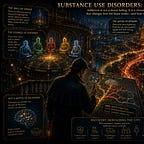

Imagine Medlock Holmes arriving in a magnificent city renowned for one remarkable feature.
Every citizen possesses complete freedom.
Every street offers choices.
Every marketplace presents opportunities.
Every day, thousands of decisions are made.
Which road to follow.
Which people to trust.
Which risks to take.
Which pleasures to pursue.
At the centre of the city stands the Hall of Choice.
Inside, an intricate council carefully weighs every decision.
Reason speaks.
Memory offers advice.
Emotion contributes experience.
Future consequences are considered.
Rewards are balanced against risks.
Normally, the system works beautifully.
Citizens enjoy pleasure without becoming enslaved by it.
They recover from disappointment.
They learn from mistakes.
They adapt.
Then Holmes notices something unsettling.
Certain visitors begin arriving in the city.
Some carry bottles.
Others offer powders.
Some bring pills.
Others introduce smoke, vapour, crystals, or injections.
At first, these visitors seem harmless.
They promise relief.
Confidence.
Energy.
Sleep.
Escape.
Pleasure.
The citizens welcome them.
Nothing appears unusual.
But gradually, something changes.
The Hall of Choice no longer governs the city.
Its conversations become quieter.
Its influence weakens.
Meanwhile, another building grows larger with every passing day.
The House of Reward.
Here, powerful messengers flood the city with signals of pleasure, relief, and desire.
Each visit strengthens its authority.
Each return becomes easier.
Each absence becomes harder to tolerate.
Soon, the city’s choices no longer feel like choices at all.
Holmes realises he is not investigating a failure of morality.
He is investigating a disease of decision-making.
This chapter introduces substance use disorders as chronic biopsychosocial illnesses that reshape the brain, behaviour, and environment together.
Addiction is not defined simply by the presence of a substance.
It is defined by a pattern.
Repeated use despite accumulating harm.
Powerful cravings.
Difficulty reducing or stopping.
Loss of control.
The consequences spread throughout the city.
Relationships begin to fracture.
Employment suffers.
Physical health deteriorates.
Mental illness becomes more severe.
Communities feel the burden.
Families struggle to understand why promises repeatedly become broken.
Holmes discovers that modern psychiatry no longer views addiction as a failure of willpower.
Instead, it recognises an illness arising from the interaction of biology, psychology, social circumstances, trauma, stress, learning, and environment.
The chapter also introduces the language clinicians use to understand these disorders.
Gone is the older distinction between “abuse” and “dependence.”
Instead, substance use disorders exist along a continuum of severity.
Some individuals experience relatively mild impairment.
Others develop profound disruption affecting nearly every aspect of life.
The degree of illness matters because treatment must be matched to need.
As Holmes continues his investigation, he travels through different districts of the city.
One neighbourhood struggles with alcohol.
Another with opioids.
Others face stimulants, cannabis, tobacco, sedatives, hallucinogens, inhalants, and newer synthetic substances.
Although each district has unique challenges, Holmes notices that they all share remarkably similar patterns.
The substances differ.
The disease does not.
The investigation then widens beyond individual patients.
Holmes steps onto a tower overlooking the entire landscape.
He sees waves of addiction moving through populations.
The opioid crisis.
The rise of fentanyl.
Increasing alcohol-related harm.
The growing use of stimulants.
Changing cannabis laws.
The emergence of vaping.
Each reflects the complex interaction between medicine, public policy, economics, culture, and human behaviour.
Yet Holmes also finds reasons for hope.
Recovery centres stand throughout the city.
Doctors.
Psychologists.
Peer recovery coaches.
Families.
Support groups.
Medications.
Behavioural therapies.
Community programmes.
No single intervention rebuilds the city alone.
Recovery is constructed through many pathways working together.
The greatest lesson of the chapter becomes increasingly clear.
The opposite of addiction is not simply abstinence.
It is the gradual restoration of choice.
As Holmes leaves the Hall of Choice, its lights begin to shine once again.
Not because temptation has disappeared.
But because the city’s ability to choose its future has slowly returned.
Key Takeaways
Substance use disorders are chronic biopsychosocial diseases rather than moral failings.
Addiction is characterised by impaired control, craving, continued use despite harm, and physiological adaptation.
DSM-5-TR conceptualises substance use disorders along a spectrum of severity rather than separate categories of abuse and dependence.
Biological vulnerability, psychological factors, trauma, social influences, and environmental circumstances all contribute to addiction.
Different substances affect the brain in different ways but share common underlying mechanisms involving reward and impaired decision-making.
Substance use disorders commonly coexist with other psychiatric disorders and significantly increase morbidity and mortality.
Public health crises, including the opioid epidemic and increasing stimulant use, demonstrate the societal impact of addiction.
Effective treatments include medications, psychological therapies, peer support, and long-term recovery-oriented care.
Recovery often involves periods of remission and relapse, similar to other chronic medical illnesses.
Successful treatment focuses not only on reducing substance use but on restoring health, functioning, and the ability to make autonomous choices.


