
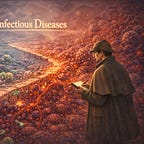

This episode explores infectious disease as a dynamic interaction between invading organisms and host defences. Microbes are not simply causes of disease. They are biological agents with their own survival strategies, shaped by evolution to colonise, replicate, evade immunity, and transmit to new hosts. Disease emerges from the balance, or imbalance, between microbial virulence and host resistance.
The episode begins by introducing the major classes of infectious agents, including bacteria, viruses, fungi, parasites, and prions. Each is framed not by taxonomy alone, but by how it causes injury. Some organisms damage tissues directly through toxins or replication. Others provoke excessive host responses that produce more harm than the pathogen itself.
Mechanisms of microbial pathogenicity are then examined. Adhesion, invasion, intracellular survival, immune evasion, and toxin production are explored as deliberate biological strategies rather than accidental features. The episode highlights how small molecular interactions can determine whether infection remains localised, disseminates, or becomes chronic.
Host response is examined as the other half of the equation. Innate and adaptive immune defences work to contain infection, but these responses can also produce collateral damage. Granuloma formation, abscesses, and chronic inflammatory states are presented as negotiated outcomes rather than failures of immunity.
The episode then explores patterns of tissue injury in infection. Acute inflammation, necrosis, fibrosis, and organ dysfunction are traced back to specific pathogen host interactions. Special attention is given to opportunistic infections and infections in immunocompromised hosts, emphasising how disease expression depends as much on the host as on the organism.
Finally, the episode addresses emerging and re emerging infections. Microbial evolution, antimicrobial resistance, global movement, and ecological disruption are presented as forces reshaping infectious disease patterns. Infection is framed not as a solved problem, but as an ongoing biological contest.
Key takeaways
Infectious disease reflects interaction between pathogen virulence and host defence
Microbes cause injury through direct damage and immune mediated mechanisms
Host response determines disease severity and pattern
Immunocompromised states reveal hidden pathogenic potential
Microbial evolution and resistance continue to reshape infectious disease


