
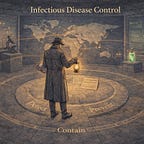

Infectious disease control remains one of the foundational pillars of public health. From historical epidemics to modern global outbreaks, communicable diseases test surveillance systems, laboratory networks, vaccination programmes, and international cooperation.
This chapter explores disease transmission dynamics, reproduction numbers, case definitions, surveillance systems, contact tracing, vaccination strategies, antimicrobial resistance, and outbreak containment. It considers both endemic diseases and emerging threats in a globally connected world.
Control is presented as a layered system - prevention, detection, response, containment, and recovery. Effective infectious disease control requires preparedness infrastructure, rapid data sharing, public trust, and cross-border coordination.
Microbial threats may be microscopic, but their management is systemic.
Key Takeaways
Surveillance systems are central to early detection.
Transmission dynamics guide control strategies.
Vaccination remains one of the most effective prevention tools.
Case definition and contact tracing underpin outbreak management.
Antimicrobial resistance threatens treatment effectiveness.
Global coordination strengthens epidemic response.
Preparedness must be continuous, not reactive.


