
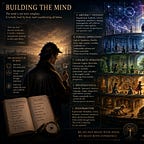

This chapter explores how human cognition develops across childhood through the pioneering work of Jean Piaget. Rather than viewing children as miniature adults, Piaget proposed that thinking evolves through distinct stages, each representing a qualitatively different way of understanding the world.
At the core of his theory are two fundamental processes: assimilation and accommodation. Assimilation involves interpreting new experiences through existing mental frameworks, while accommodation requires modifying those frameworks when reality no longer fits. Development emerges from the tension between these processes - a continuous effort to achieve cognitive equilibrium.
Piaget described four major stages of development. In the sensorimotor stage, infants learn through action and sensory experience, gradually developing object permanence. The preoperational stage introduces symbolic thinking, but remains limited by egocentrism and lack of logical structure. The concrete operational stage brings logical reasoning about tangible objects, while the formal operational stage allows for abstract, hypothetical thinking.
A key theme is that cognitive development is not simply the accumulation of knowledge, but the transformation of how knowledge is structured. Each stage represents a new architecture of thought.
Clinically and developmentally, this framework helps us understand not only normal development, but also deviations - where cognitive structures may be delayed, disrupted, or atypically organised.
Key Takeaways
Cognitive development occurs through qualitatively distinct stages.
Assimilation and accommodation drive learning and adaptation.
Development reflects restructuring of thought, not just accumulation of knowledge.
Early cognition is action-based; later cognition becomes abstract and symbolic.
Egocentrism decreases as perspective-taking develops.
Logical reasoning emerges gradually and is initially tied to concrete experience.
Understanding developmental stage is essential for interpreting behaviour and symptoms.


