
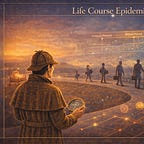

In this episode, Medlock Holmes steps away from snapshots of disease and instead examines the long arc of health across an entire lifetime.
Life course epidemiology asks a transformative question: How do exposures at different stages of life influence later health outcomes? Health is not merely the product of present conditions - it is layered, cumulative, and shaped by timing.
Holmes explores three central conceptual models:
Critical period model - where exposures during specific windows (e.g., in utero, early childhood) have lasting effects.
Accumulation model - where risk builds progressively over time.
Pathway (or chain-of-risk) model - where early exposures influence later trajectories indirectly.
We examine examples that illustrate these principles:
Fetal programming and adult cardiovascular disease
Childhood adversity and adult mental health
Socioeconomic disadvantage and chronic disease accumulation
Intergenerational transmission of risk
Holmes also discusses methodological challenges: long follow-up periods, cohort attrition, measurement consistency, and disentangling age, period, and cohort effects.
This episode reframes public health from reactive treatment to strategic timing. Prevention may begin decades before disease appears.
Life course epidemiology reminds us that timing is as important as exposure.
Key Takeaways
Health outcomes are shaped across the entire lifespan.
Critical periods represent windows of heightened biological sensitivity.
Risk may accumulate progressively over time.
Early exposures can influence later life trajectories indirectly.
Age, period, and cohort effects must be analytically distinguished.
Longitudinal study designs are central to life course research.
Early intervention may yield the greatest long-term benefit.


