
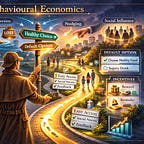

In this episode, Medlock Holmes steps into the subtle terrain between rational theory and real human behaviour.
Traditional economics assumes that individuals make rational decisions to maximise benefit. Behavioural economics challenges this assumption. People are influenced by cognitive biases, heuristics, framing, defaults, loss aversion, and social norms.
Holmes explores how these behavioural tendencies shape health choices:
Why people delay vaccination
Why smoking persists despite known risks
Why default options increase organ donation rates
Why small incentives can alter behaviour
We examine key behavioural concepts:
Loss aversion
Present bias
Status quo bias
Framing effects
Social proof
Nudge theory
Holmes illustrates how small structural adjustments - such as changing defaults, simplifying forms, or reframing messages - can significantly influence population behaviour without removing freedom of choice.
The episode also considers ethical debates. When does nudging become manipulation? How transparent should behavioural interventions be? What are the limits of paternalism?
Behavioural economics reveals that public health does not operate in purely rational landscapes. It operates in human ones.
Key Takeaways
Human decision-making is influenced by predictable biases.
Present bias often undermines long-term health behaviour.
Defaults can strongly influence uptake of interventions.
Framing shapes perception of risk and benefit.
Nudges preserve choice while guiding behaviour.
Ethical considerations must accompany behavioural design.
Behaviourally informed policy can enhance effectiveness.


