
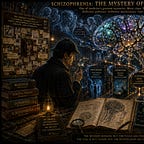

Schizophrenia is one of the most misunderstood disorders in medicine. It is not simply a condition of hallucinations and delusions; it is a disorder that disrupts perception, cognition, motivation, emotion, and the ability to connect with the world. For centuries it was viewed as madness, then as degeneration, later as a dopamine disorder, and now increasingly as a disorder of brain circuits, neurodevelopment, and dysfunctional neural networks.
In this opening chapter of the schizophrenia series, Medlock Holmes begins the investigation by asking a deceptively simple question:
What actually goes wrong inside a brain that loses its grip on reality?
We explore the historical evolution of schizophrenia-from ancient descriptions of prophets and visionaries to modern neuroscience-and examine why the illness remains one of psychiatry’s greatest scientific challenges. The episode introduces psychosis not as a single disease but as a complex symptom that may arise from multiple underlying biological mechanisms.
The chapter also explains why modern psychiatry is gradually moving beyond rigid diagnostic labels towards studying dimensions of dysfunction such as psychosis, cognition, negative symptoms, and affective disturbance. Rather than one illness with one cause, schizophrenia may represent several overlapping diseases sharing common clinical features.
Finally, we examine why medication alone is never enough. The strongest evidence now shows that early comprehensive intervention-including psychological therapies, cognitive remediation, family education, community support, and pharmacological treatment-offers the greatest opportunity for long-term recovery.
This episode serves as the gateway to the entire schizophrenia section, introducing the detective framework that will guide the chapters ahead as we investigate genetics, neurodevelopment, imaging, cognition, treatment, recovery, and the biology of psychosis itself.
Key Takeaways
• Schizophrenia is far more than hallucinations.
It affects multiple domains including perception, cognition, motivation, emotion, social functioning, and independent living.
• Psychosis remains one of neuroscience’s greatest mysteries.
Understanding the neural mechanisms of psychosis is central to discovering better treatments and biologically based disease classifications.
• Dopamine explains treatment-but probably not the whole disease.
Current antipsychotics reduce dopamine signalling effectively, yet schizophrenia likely involves multiple interacting neural circuits extending well beyond dopamine.
• Modern research is shifting from diagnoses to dimensions.
Instead of asking “What diagnosis does this patient have?”, researchers increasingly ask which domains-psychosis, cognition, negative symptoms or mood dysfunction-are disrupted.
• Schizophrenia is biologically heterogeneous.
Patients sharing the same diagnosis may have very different underlying disease mechanisms.
• Basic neuroscience is essential.
Understanding memory, synaptic plasticity, neural circuitry and cortical communication is increasingly necessary for understanding schizophrenia.
• Comprehensive care outperforms medication alone.
The best outcomes occur when antipsychotic medication is combined with psychological therapy, cognitive remediation, family intervention, behavioural treatment, and community support.
• Early intervention changes trajectories.
The RAISE model demonstrates that coordinated early treatment during first-episode psychosis significantly improves long-term outcomes.
• The future lies in personalised psychiatry.
As biological mechanisms become clearer, schizophrenia may eventually be subdivided into distinct brain diseases with targeted treatments rather than one broad syndrome.


