
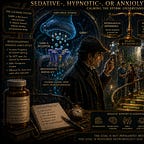

Medlock Holmes is summoned to investigate a peculiar paradox.
The patients arriving at his clinic are not chasing euphoria. Many have never bought drugs illegally. They are teachers, nurses, executives, retirees, and people living with chronic anxiety or insomnia. They followed medical advice. They took their medication exactly as prescribed.
Yet months-or years-later, many discover something unsettling.
They no longer know whether they are taking the medication because they still need it, or because their brain has quietly adapted to its presence.
Holmes begins with the brain’s principal braking system: gamma-aminobutyric acid (GABA). Under normal circumstances, GABA prevents excessive neuronal firing, maintaining calm, sleep, and emotional stability. Benzodiazepines and related sedative–hypnotics do not replace GABA; instead, they amplify its inhibitory effects, making the brain less excitable and producing anxiolysis, sedation, hypnosis, muscle relaxation, and anticonvulsant activity.
Initially, the treatment works beautifully.
Sleep returns.
Anxiety eases.
Muscles relax.
But the nervous system is designed to maintain equilibrium. With continuous exposure, GABA receptors adapt. Receptor sensitivity changes, glutamate activity increases, calcium channel function shifts, and neuroendocrine systems recalibrate. The brain quietly raises its internal “accelerator” to compensate for the external “brake.”
Holmes realises this is the critical distinction many clinicians overlook.
Physiological dependence is not the same as addiction.
A patient who develops tolerance and withdrawal after months of appropriate medical treatment has experienced normal neuroadaptation-not necessarily a substance use disorder. Addiction requires behavioural changes: compulsive use, loss of control, continued use despite harm, craving, and impairment in functioning. The distinction is clinically and ethically essential.
As Holmes follows the clues, he discovers why abrupt cessation can be dangerous.
Without the enhanced GABA activity, the now-adapted nervous system becomes relatively hyperexcitable. Minor symptoms include anxiety, insomnia, tremor, irritability, sweating, nausea, and autonomic activation. More severe withdrawal can produce hallucinations, psychosis, delirium, hyperthermia, and generalised tonic–clonic seizures. Barbiturate withdrawal, in particular, may be fatal if untreated.
Holmes then encounters another mystery.
Why are benzodiazepines generally much safer than barbiturates?
The answer lies within receptor pharmacology. Benzodiazepines are positive allosteric modulators: they require endogenous GABA before exerting their effects. Barbiturates, particularly at higher concentrations, can directly activate GABA receptors, producing profound respiratory depression. This explains why benzodiazepine overdose alone is often survivable, whereas barbiturate overdose commonly causes respiratory arrest. However, combining benzodiazepines with alcohol or opioids removes this safety margin and dramatically increases mortality.
The final chapter of the investigation concerns recovery.
Holmes rejects dramatic detoxification. Instead, he advocates patience.
Successful treatment usually involves gradual tapering-often over weeks or months-allowing the nervous system to slowly recalibrate. Longer-acting benzodiazepines such as diazepam or clonazepam are sometimes substituted to produce a smoother withdrawal. Psychological therapies, especially cognitive behavioural approaches, teach patients how to manage the anxiety that originally prompted treatment, preventing medication from remaining the sole coping strategy.
Holmes closes his notebook with a final reflection.
Sometimes the greatest clinical challenge is not recognising addiction.
It is recognising when a patient’s dependence is simply the predictable consequence of effective medicine-and helping them leave it safely without confusing treatment with failure.
Key Takeaways
Sedative-, hypnotic-, and anxiolytic-related disorders primarily involve medications that enhance GABAergic neurotransmission, especially benzodiazepines.
Physiological dependence (tolerance and withdrawal) is not synonymous with substance use disorder.
Substance use disorder requires behavioural features such as impaired control, compulsive use, craving, and continued use despite harm.
Benzodiazepines act as positive allosteric modulators of the GABA-A receptor and require endogenous GABA to exert their effects.
Barbiturates have greater overdose risk because they can directly activate GABA receptors and produce significant respiratory depression.
Tolerance develops through neuroadaptive changes involving GABA receptors, glutamate pathways, calcium channels, and stress systems.
Withdrawal symptoms range from anxiety and insomnia to seizures, delirium, hallucinations, and autonomic instability.
Abrupt cessation after prolonged treatment significantly increases withdrawal risk.
Short-acting benzodiazepines generally produce earlier withdrawal than long-acting agents.
Benzodiazepine overdose alone is often relatively safe, but combining benzodiazepines with alcohol or opioids markedly increases mortality.
Flumazenil can reverse benzodiazepine overdose in selected circumstances.
Gradual tapering is the cornerstone of withdrawal management; many patients require individualised, prolonged dose reductions.
Cognitive behavioural therapy and other psychological interventions improve successful discontinuation and long-term anxiety management.
Barbiturate withdrawal is a medical emergency because of its high risk of seizures, delirium, and death.
Good prescribing balances effective symptom relief with careful monitoring, patient education, and planned discontinuation whenever appropriate.


