
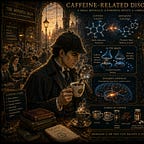

Every morning, before the city truly awakens, Medlock Holmes notices a remarkable ritual.
Office lights flicker on.
Coffee machines begin to hiss.
Kettles whistle.
Students cradle steaming mugs.
Doctors begin ward rounds with takeaway cups in hand.
Parents finally feel awake after the first sip.
Unlike the illicit drugs Holmes has investigated before, no one hides this substance.
It is celebrated.
Shared.
Offered to guests.
Embedded within culture itself.
Yet Holmes is puzzled.
How can the world’s most socially accepted psychoactive substance also be capable of intoxication, withdrawal, anxiety, insomnia, dependence, and addiction?
His newest investigation begins not in a crime scene-but in a café.
Holmes quickly discovers that caffeine is the most widely consumed psychoactive drug in the world, with around 90% of adults consuming it regularly. It is naturally present in coffee, tea, cocoa, yerba mate and many other plants, while manufacturers also add it to soft drinks, energy drinks, medications, dietary supplements and foods.
Unlike amphetamines or cocaine, caffeine works primarily by blocking adenosine receptors.
Adenosine normally acts like the brain’s biological brake pedal.
Throughout the day, adenosine gradually accumulates.
The more adenosine binds to its receptors, the sleepier we become.
Caffeine disguises itself as adenosine.
It occupies the receptor without activating it.
The brake disappears.
The brain becomes more alert.
Indirectly, dopamine signalling also increases, producing greater motivation, attention and reward.
Holmes smiles.
“The engine,” he says, “was never made stronger.”
“You merely disconnected the brakes.”
The chapter explores the remarkable pharmacology of caffeine.
After ingestion, caffeine is rapidly absorbed, reaching peak blood levels within approximately 30–60 minutes. Its average half-life is four to six hours, although this varies considerably depending on genetics, pregnancy, oral contraceptive use, smoking, liver disease and interacting medications. Slow metabolisers may experience caffeine’s effects for far longer than expected.
Holmes begins interviewing patients.
Each tells a different story.
A medical student drinks two coffees before an examination and feels focused.
A lawyer drinks six coffees and cannot stop pacing.
A teenager consumes multiple energy drinks before sport and develops palpitations.
A psychiatrist cannot function until the second cup each morning.
The same molecule.
Different brains.
Different outcomes.
Holmes learns that caffeine’s effects are strongly dose dependent.
Low to moderate doses (around 20–200 mg) typically improve alertness, energy, concentration, mood and motivation while reducing fatigue.
At higher doses (usually ≥400 mg), benefits begin to disappear.
Instead, anxiety, nervousness, tremor, jitteriness and restlessness emerge. Performance may actually worsen despite feeling more awake.
He remarks:
“The dose decides whether caffeine becomes an ally-or an adversary.”
His next investigation concerns caffeine intoxication.
Unlike alcohol intoxication, most people never intend to become intoxicated with caffeine.
Instead, it happens accidentally.
Extra coffees during deadlines.
Multiple energy drinks during examinations.
Workout supplements combined with coffee.
Weight-loss tablets.
Cold medications.
The total quietly accumulates.
DSM-5-TR suggests intoxication generally follows recent consumption well above 250 mg, although more severe presentations often involve much larger doses. Typical symptoms include:
Restlessness
Nervousness
Excitement
Insomnia
Diuresis
Gastrointestinal upset
Muscle twitching
Rambling speech
Tachycardia
Psychomotor agitation
Severe overdose may produce vomiting, seizures, delirium, arrhythmias and, rarely, death. Fatal toxicity is uncommon and usually involves caffeine tablets or powder rather than beverages.
Holmes notices something interesting.
Patients rarely realise that their “panic attack” may actually be caffeine intoxication.
The next mystery surprises him even more.
Not intoxication.
Withdrawal.
One woman develops a terrible headache every Sunday morning.
Another develops “influenza” during religious fasting.
A surgeon repeatedly experiences postoperative headaches.
Each mystery has the same explanation.
No caffeine.
The chapter explains that regular caffeine use produces genuine physical dependence. Withdrawal typically begins 12–24 hours after cessation, peaks during the first 48 hours and usually resolves within two to nine days. The hallmark symptom is headache, but fatigue, drowsiness, depressed mood, poor concentration, irritability, nausea, muscle aches and flu-like symptoms are also common. Even relatively modest daily consumption (around 100 mg) may produce withdrawal in susceptible individuals.
Holmes reflects:
“People often mistake withdrawal for illness.”
“In reality, they are experiencing the absence of something they believed they never depended upon.”
Another patient arrives convinced she has developed an anxiety disorder.
Holmes notices something unusual.
She drinks eight large coffees every day.
Her anxiety worsens steadily throughout the afternoon.
Rather than prescribing anxiolytics immediately, Holmes performs a simple experiment.
He gradually reduces her caffeine intake.
The anxiety disappears.
The chapter describes caffeine-induced anxiety disorder, recognising that caffeine may precipitate panic attacks or clinically significant anxiety, particularly in susceptible individuals or those with existing anxiety disorders. A trial of caffeine reduction or abstinence is often diagnostically useful before escalating pharmacological treatment.
Sleep presents another paradox.
Many people drink coffee because they are tired.
Later, they cannot sleep because they drank coffee.
The following morning they require more coffee.
Holmes sketches a circle.
Fatigue.
Coffee.
Poor sleep.
More fatigue.
More coffee.
The chapter explains caffeine-induced sleep disorder, most commonly insomnia. Even 200 mg consumed before bedtime may delay sleep onset, reduce total sleep time and impair sleep quality, while caffeine taken earlier in the day may still affect sleep later that night in sensitive individuals. Although habitual users develop partial tolerance, the sleep-disrupting effects are never completely eliminated.
Holmes is initially reluctant to believe that caffeine can produce a genuine use disorder.
After all...
People joke about “coffee addiction.”
The chapter suggests the joke is sometimes true.
DSM-5-TR currently lists Caffeine Use Disorder as a condition for further study.
The proposed diagnosis requires three core features:
Persistent unsuccessful attempts to reduce caffeine.
Continued use despite physical or psychological harm.
Withdrawal leading to continued consumption.
Research suggests that approximately 8–13% of regular caffeine users may meet proposed diagnostic criteria, with many reporting significant distress, anxiety, insomnia and repeated failed attempts to stop.
Holmes quietly observes:
“Addiction is not measured by legality.”
“It is measured by loss of choice.”
Treatment proves refreshingly simple-but not always easy.
Unlike illicit stimulants, complete abstinence is often unnecessary.
Most patients benefit from gradual reduction.
The authors recommend:
Educating patients about hidden caffeine sources.
Recording daily caffeine intake.
Setting realistic reduction goals.
Reducing intake by approximately 25% each week.
Substituting decaffeinated alternatives.
Using behavioural strategies similar to other substance use disorders.
Abrupt cessation is generally discouraged because withdrawal itself often causes relapse. Randomised studies demonstrate that structured behavioural reduction programmes can substantially reduce caffeine consumption while improving anxiety, sleep and quality of life.
As Holmes leaves the café, he notices something he had overlooked all morning.
Nobody drinks coffee simply because it tastes pleasant.
Some drink it to wake.
Some to work.
Some to think.
Some merely to feel normal.
He realises that caffeine is unique.
Unlike many psychoactive drugs, it quietly weaves itself into ordinary life until its absence becomes louder than its presence.
The mystery, Holmes concludes, is not why caffeine changes the brain.
The mystery is how easily we forget that it does.
Key Takeaways
Caffeine is the world’s most widely consumed psychoactive substance.
It acts primarily by antagonising adenosine receptors, indirectly increasing dopaminergic activity.
Low doses improve alertness and concentration, whereas high doses commonly cause anxiety, jitteriness and insomnia.
Caffeine intoxication presents with restlessness, tachycardia, gastrointestinal symptoms, tremor and psychomotor agitation.
Chronic caffeine use produces genuine physical dependence and a well-defined withdrawal syndrome.
Withdrawal usually begins within 12–24 hours and is characterised by headache, fatigue, low mood and impaired concentration.
Caffeine may induce clinically significant anxiety and sleep disorders, particularly in susceptible individuals.
Caffeine Use Disorder is recognised in DSM-5-TR as a condition for further study.
Behavioural treatment focuses on gradual reduction rather than abrupt cessation.
Clinicians should routinely assess caffeine intake when evaluating anxiety, insomnia, headaches and unexplained physical symptoms.


