
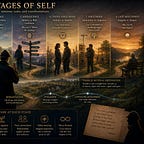

This chapter explores Erik Erikson’s influential model of psychosocial development, which extends the understanding of human growth across the entire lifespan. Unlike earlier theories that focused primarily on childhood, Erikson proposed that development continues through a sequence of stages, each defined by a central psychological task.
Each stage presents a tension - a conflict between two opposing forces, such as trust versus mistrust, autonomy versus shame, or identity versus role confusion. These are not problems to be solved once and for all, but dynamic balances that shape personality over time.
A key theme is that development is cumulative. Earlier stages lay the foundation for later ones, but they are not fixed - unresolved conflicts can be revisited and renegotiated throughout life. Identity, in particular, emerges as a central task during adolescence, but continues to evolve in adulthood.
Erikson also emphasised the social dimension of development. The individual is not developing in isolation, but within a cultural and relational context that shapes expectations, roles, and opportunities.
Clinically, this framework provides a lens for understanding where an individual may be struggling within their developmental trajectory. It reframes distress not simply as pathology, but as difficulty in negotiating key life tasks.
Ultimately, Erikson’s model presents development as a lifelong process - a continuous unfolding of the self in relation to others and the world.
Key Takeaways
Development occurs across the entire lifespan, not just in childhood.
Each stage involves a psychosocial conflict or tension.
Successful development requires negotiating, not eliminating, these tensions.
Earlier stages influence later development but can be revisited.
Identity formation is a central task, particularly in adolescence.
Social and cultural context shape developmental processes.
Psychological distress can reflect difficulty in developmental negotiation.


