
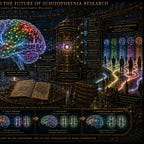

Medlock Holmes stands before the final chamber of the Neuroimaging Institute.
Around him are the tools he has mastered throughout his investigation.
MRI reveals the brain’s architecture.
Diffusion imaging maps its white matter highways.
PET uncovers its chemistry.
Magnetic resonance spectroscopy measures its metabolites.
Functional MRI watches neural networks come alive.
Each technique has solved part of the mystery.
Yet none has explained schizophrenia on its own.
Holmes smiles.
The greatest detectives never rely upon a single clue.
Neither should neuroscience.
The room transforms into an immense circular observatory. Every imaging modality projects its own transparent map of the same brain. Slowly the maps begin to overlap.
Grey matter loss aligns with disrupted white matter tracts.
Abnormal dopamine release coincides with impaired salience networks.
Glutamate abnormalities correspond with dysfunctional hippocampal circuits.
Functional dysconnectivity mirrors structural disconnection.
The fragmented evidence begins to form a single coherent picture.
Schizophrenia is increasingly understood not as a disease affecting one neurotransmitter, one brain region, or one network, but as a complex systems disorder involving multiple interacting biological levels. Modern neuroimaging increasingly integrates structural MRI, diffusion imaging, functional MRI, PET, magnetic resonance spectroscopy, genetics, cognition, and clinical phenotyping to better understand this complexity.
Holmes next encounters the challenge of diagnosis.
Can neuroimaging diagnose schizophrenia?
Not yet.
Although group differences between patients and healthy controls are robust, individual variability remains substantial. Many imaging abnormalities overlap with bipolar disorder, major depression, autism spectrum disorders, and even healthy individuals with elevated genetic risk. Consequently, neuroimaging remains primarily a research tool rather than a standalone diagnostic test.
The investigation turns toward biomarkers.
Researchers search for objective biological signatures capable of predicting illness before symptoms fully emerge.
Some biomarkers aim to identify individuals at ultra-high risk for psychosis.
Others attempt to predict which patients will respond to particular antipsychotic medications.
Still others seek indicators of cognitive decline, functional recovery, or long-term prognosis.
No single biomarker has yet achieved sufficient sensitivity, specificity, and reproducibility for routine clinical use. Instead, the greatest promise lies in combining multiple biological, cognitive, and clinical measures into integrated prediction models.
Holmes watches another innovation unfold.
Artificial intelligence enters the laboratory.
Powerful machine-learning algorithms analyse thousands of imaging variables simultaneously.
Patterns invisible to human observers begin to emerge.
Rather than examining one brain region at a time, these algorithms evaluate whole-brain relationships across structural, functional, and molecular datasets.
Classification accuracy improves considerably when multimodal imaging is combined with demographic, genetic, and neuropsychological information. However, external validation, reproducibility across scanners, and clinical interpretability remain major challenges before these methods can be routinely implemented.
The observatory expands still further.
Longitudinal imaging follows individuals across decades.
Instead of asking what schizophrenia looks like, investigators ask how it develops.
Children with genetic vulnerability.
Adolescents experiencing subtle cognitive changes.
Young adults entering first-episode psychosis.
Patients recovering after treatment.
The same individuals are studied repeatedly, allowing investigators to distinguish developmental abnormalities from illness progression and treatment effects.
Holmes realises that understanding change may ultimately prove more valuable than describing a single moment in time.
Finally, precision psychiatry emerges.
Rather than treating schizophrenia as one disorder, future medicine may identify biologically distinct subtypes.
One patient may have predominantly dopaminergic dysfunction.
Another may exhibit glutamatergic abnormalities.
A third may demonstrate severe dysconnectivity within cognitive control networks.
Each subtype could eventually receive different targeted interventions based upon its unique biological profile.
The era of personalised psychiatry begins to appear on the horizon.
Holmes gazes once more at the unified brain projected above him.
Thousands of images.
Millions of measurements.
Countless neural conversations.
None alone provides the answer.
Together they reveal something extraordinary.
Schizophrenia is not a puzzle solved by one technology.
It is a mystery illuminated through the convergence of many ways of seeing.
As the lights fade, Holmes closes his notebook.
The investigation is not finished.
It has only learned to ask better questions.
Key Takeaways
Modern schizophrenia research increasingly combines multiple neuroimaging modalities rather than relying on a single technique.
Structural MRI, diffusion imaging, PET, magnetic resonance spectroscopy, and functional MRI each contribute complementary information.
Schizophrenia is increasingly conceptualised as a systems-level disorder involving interacting structural, functional, and neurochemical abnormalities.
Multimodal imaging helps integrate anatomical, connectivity, metabolic, and functional findings into unified disease models.
Current neuroimaging cannot reliably diagnose schizophrenia in individual patients.
Significant overlap exists between imaging findings in schizophrenia and other psychiatric disorders.
Imaging biomarkers are being investigated for early detection, prognosis, and treatment prediction.
No imaging biomarker currently possesses sufficient accuracy for routine clinical diagnosis.
Machine-learning techniques can identify complex imaging patterns that exceed traditional statistical approaches.
Artificial intelligence performs best when imaging data are combined with clinical, cognitive, and genetic information.
Reproducibility and external validation remain major barriers to clinical implementation of AI models.
Longitudinal neuroimaging helps distinguish neurodevelopmental abnormalities from progressive illness changes.
Imaging studies increasingly focus on individuals at clinical high risk for psychosis.
Precision psychiatry aims to classify biologically meaningful subtypes rather than relying solely on symptom-based diagnosis.
Future treatments may target specific biological mechanisms identified through multimodal imaging.
Neuroimaging continues to deepen understanding of schizophrenia while complementing-rather than replacing-careful clinical assessment.
The future of schizophrenia research lies in integrating imaging, genetics, cognition, biomarkers, and computational neuroscience into a unified framework.


