
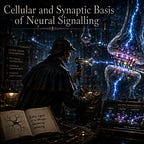

Beneath every thought, emotion, and behaviour lies a fundamental process: communication between neurons. This chapter explores how individual brain cells generate, transmit, and modulate signals - forming the basis of all mental activity.
In this episode, we examine the neuron as both an electrical and chemical entity. Electrical signals travel along axons as action potentials, while communication between neurons occurs at synapses through the release of neurotransmitters. This dual system allows for both speed and flexibility.
We explore how synaptic transmission is not simply a relay, but a point of modulation. Signals can be amplified, dampened, or reshaped depending on receptor types, neurotransmitter availability, and downstream intracellular processes. The brain is therefore not a fixed circuit, but a constantly adjusting system.
Plasticity emerges as a central theme - the ability of synapses to strengthen or weaken over time. This underpins learning, memory, and adaptation, but also contributes to dysfunction when regulation goes awry.
Understanding these processes provides a mechanistic foundation for psychiatry. Many treatments - from medications to neuromodulation - ultimately act by altering signalling at the synaptic level.
This chapter invites a shift in perspective: to see symptoms not just as experiences, but as patterns of signalling - altered conversations between cells.
Key Takeaways
Neural signalling involves both electrical (action potentials) and chemical (synaptic transmission) processes.
Synapses are active sites of modulation, not passive relays.
Neurotransmitters interact with specific receptors to shape downstream effects.
Intracellular signalling pathways influence how signals are processed and adapted.
Synaptic plasticity underlies learning, memory, and behavioural change.
Dysregulation of signalling contributes to psychiatric disorders.
Many psychiatric treatments act by modifying synaptic transmission and plasticity.


