
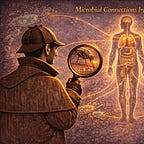

This final episode synthesises the entire microbiology journey by reorganising pathogens according to body systems and clinical presentations. Drawing from Murray’s Chapter 78, it shifts the lens from organism-based classification to patient-centred pattern recognition.
Instead of asking, “What is this microbe?”, this chapter asks:
What organisms cause pneumonia?
Which pathogens lead to meningitis?
What microbes are associated with urinary tract infections, diarrhoea, endocarditis, or sexually transmitted infections?
The episode integrates bacteria, viruses, fungi, and parasites within common clinical syndromes. It highlights how host factors - age, immune status, hospital exposure, geography - shape likely pathogens.
Conceptually, this chapter completes the circle: from taxonomy and structure to bedside reasoning. It trains the clinician to think in patterns, probabilities, and anatomic localisation.
Clinically, this integrative approach mirrors real-world diagnostic thinking.
Key Takeaways
Organ-system thinking complements organism classification
Clinical syndromes narrow differential diagnosis
Host factors influence likely pathogens
Integration across microbiology domains is essential
Pattern recognition drives practical diagnosis


