
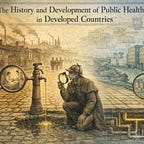

Public health did not emerge in lecture theatres. It emerged in overcrowded cities, in the shadow of epidemics, and in response to social upheaval.
In this episode, we trace the development of public health in high-income countries - from the sanitary movement of the nineteenth century to the institutionalisation of welfare states in the twentieth. We explore how industrialisation, urbanisation, and poverty created conditions for infectious disease outbreaks, and how reformers used data, political advocacy, and engineering solutions to transform cities.
Figures such as Edwin Chadwick and John Snow symbolise two essential public health tools: structural reform and epidemiological reasoning. The sanitary revolution - sewage systems, clean water, housing reform - dramatically reduced mortality long before antibiotics became available.
The episode then moves into the bacteriological era, where germ theory refined understanding of causation and catalysed vaccination programmes and surveillance systems. We examine how the expansion of state responsibility for health in the twentieth century laid foundations for national health systems, regulatory frameworks, and social protection policies.
Importantly, we also reflect on the tensions that accompanied this evolution - debates about state intervention, personal liberty, and the role of medicine versus prevention.
Public health in developed countries evolved through crisis, political negotiation, scientific advancement, and moral commitment to collective well-being. Its trajectory reveals a central lesson: progress in health is rarely accidental - it is constructed.
Key Takeaways
Industrialisation and urbanisation were catalysts for modern public health systems.
The sanitary movement preceded and outperformed early medical therapies in reducing mortality.
Epidemiology emerged as a powerful investigative and advocacy tool.
Germ theory refined causal understanding and strengthened prevention strategies.
The rise of welfare states institutionalised public responsibility for health.
Public health progress depended on political will as much as scientific evidence.
Tensions between individual liberty and collective health are historically persistent.
Developed country public health systems are products of social reform, not purely medical innovation.


